_

Showing posts with label organization. Show all posts

Friday, February 2, 2024

Paint Organization and Distribution Tips

 Here are some quick tips to make paint distribution and storage easier in your high school art class. This system has worked for me in a 41 minute period setting and a 78 minute block setting. For reference, this is a small classroom (no walk in closet) and another teacher uses my room during another block as well.

Option 1: Individual palettes. I have a shelf for students to keep their palettes on. Assigning a numbered spot let's them know that I know who's being messy. I can fit 20 of the 7" round palettes with wells on each shelf. 

Pro: cuts down on waste. Easy to save mixed colors

Con: have to mist with water and wrap palette daily. 


Option 2: Cups of paint. I have a tin of each primary, secondary and neutral color. Each pair of students gets 1 cup of each color to share. They access it from a communal table. At end of class they return the cup. I mist all tins with water and put the lid on. You can also add a wet sponge to keep paints moist over a long weekend. For my upper levels I have two kids share one of these tins for the duration of the project.
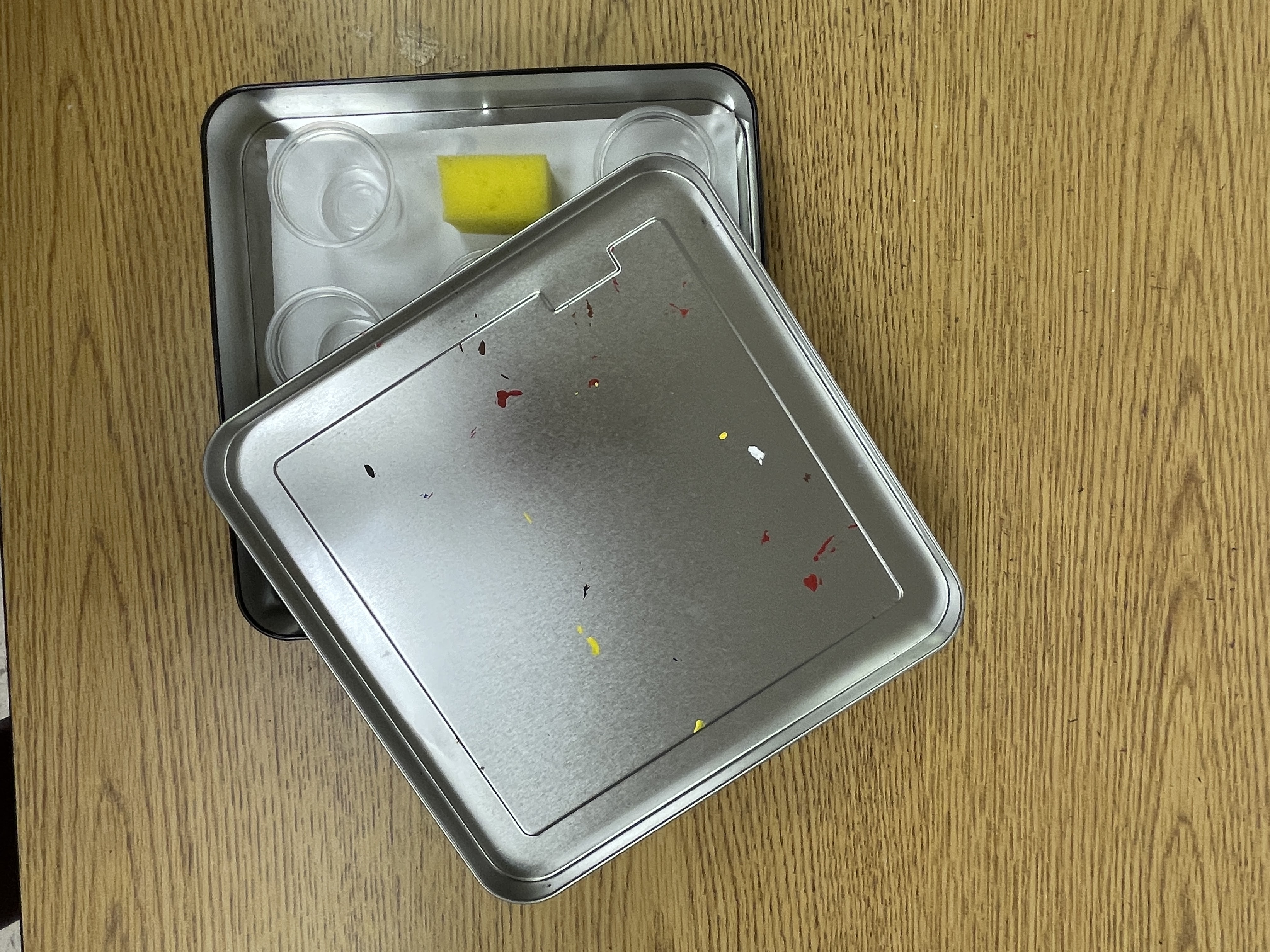

Pro: These stack neatly and take up less room than traditional palettes.


You could also use cheap dollar store pencil cases


Con: Students will need palette paper, you need to buy and replace the cups or trim the palette paper to fit the size of the box.

Tip: I keep the wax / palette paper in a readily accessible location for quick self service.


For paintbrushes you can try the over the door shoe hanger. I number each kit and each pouch space. 
At the end of class I can scan quickly to see who's missing. Also, I don't have enough for every student. Student #5 in my first class shares with Student #5 in my second class. I tell them to let me know if the brush is dirty at the beginning of class. Then I make a note to speak to that student the next day. It only takes 1 or 2 kids for them to realize that they can't get away with not washing brushes.
Pro: kids check brushes instead of you, saving time.
Con: brushes not cleaned last period of day will be gross the next day
Fun Fact: sometimes students tell on themselves. I had a kid show me a horrible brush. When I looked to see who shared the set, the student in the other class was absent. So he was the last to use (and not clean) the brushes.


Tuesday, July 25, 2023

2023 2024 Art Teacher Planner

Evolution of an art teacher plan book (left to right)

When I was teaching in 3 elementary buildings per week it didn't make sense to carry a plan book back and forth between buildings. During those 8 years, I kept a digital planbook in excel. It was really just a snapshot of what we would do each day. I had a tab for each school so I could plan from anywhere. I printed out my formal lesson plans and left those on the desk for subs just in case.

Fast forward to 2020. I couldn't wait to be done looking at a screen after remote teaching. I resorted to a plan book that was scraps of paper and sticky notes all over the place. So I went back to a paper planner. 

Over the past several years I have been modifying and tweaking my planbook and upon request making the templates available on TpT. One major change is transitioning away from "block" style to a self dividing layout like this one:


I love the flexibility this offers. If we're in progress on a lesson, I don't need the same amount of space as an intro day. This is also a good visual cut to how crazy the day is going to be and helps me prevent have a day of intros in every class. If there is too much to fit in that column it's going to drain my battery. So sometimes I will switch things up when I see how the different classes are going to align. 

Recently, I have noticed is a need for more "communication logs" to document parent conversations. 


I like to put my Note to Subs on the first page opposite my schedule.  


This year I added a beginning of year checklist. We do many of these things on autopilot but it feels good to check them off!


Year at a glance important dates. I fill this in during the 1st faculty meeting of the year. It's helpful to refer back to this timeline things like standardized testing, etc.


Monthly calendar - I go with M-F only to allow more space. The weekends are mine and don't need to be in my school planner. 


I alternate a notes page with a coloring page (because sometimes those meetings aren't really for art teachers)


Quick place to jot down any supplies that get used up. 
All in one handy spot for ordering at end of year.


The Visual Art Standards quick reference in the back of book as well as an End of Year Checklist. This is new this year, but I found our district checklist had a minimal amount of items that didn't encompass what I really need to do to close out my room for the year.


Here's what it looks like all put together for this year:


What are some must have non-negotiable features in your plan book?


Monday, June 6, 2022

End of Year Checklist

 There are a few things you can do during the last week of school that will make future you super thankful.


1. Test & Toss

With student assistance or on your own check markers. Snap those caps. That goes for glue sticks as well. I also like to consolidate supplies. If I find that I somehow have two open bottles of red paint I try to get them into one.  This is also the time to check your "First in First Out" organization. I write the date on my paint bottles and other expensive supplies. Throughout the year, stock doesn't always get rotated properly, so it's a good time to get things back in order.

2. Take Inventory and submit your supply order for next year

If you normally revamp your curriculum over the summer, save a portion of your budget. I usually spend about three quarters of my budget before I walk out the door, because there are some staples that you just have to have. This year I had a ton of things on backorder due to supply chain issues and it made for a bit of shuffling around. Do yourself a favor and get the order placed now.  If your district window is closed you can add items to your shopping cart or list while it's fresh in your mind.


3. Clean out your desk

Take home any food or medicine that you may keep on hand before it expires or is found by critters. I like to wipe down the surfaces and reorganize the space inside using cheap drawer dividers. Even though it feels like I am always putting things away, somehow I manage to find a dozen random sharpies sprinkled around in all the drawers. 


4. File everything using a system.


Fight the urge to stuff things in a drawer. Use a manilla folder, envelope or binder to keep records separated by semester or year for easy reference if needed. It's a great time to go through your old records and toss items that are no longer needed. Check with your admin on how long teachers should hang onto gradebooks, etc.


An often overlooked system is our virtual drives. While your district may archive student or course info, have you taken a moment to tidy up your google drive? I find it helpful to create a new empty folder every year for lesson plans. If I plan to reuse a lesson I can drag it over. Otherwise I can open last year's file and make necessary edits and save as into the new folder. I like this method, because if the new lesson doesn't go as planned, I still have a record of the old plan.


5. Map it out

I have found that posting a map of my preferred room layout is greatly appreciated by custodians.  Sometimes there are seasonal helpers moving big pieces out for floor waxing (not your normal every day custodian) and when it comes time to move back in, they may just set things up in a way that makes sense to them. I staple a copy to my front bulletin board so it doesn't get lost.


6. First week Photocopies


Do you have a limited number of copies per year, quarter or month? If so, why not get a jump on next year's copies by knocking out some of the items you may use the first week. This might include a course syllabus or behavior contract, a "Meet the Teacher" paper for open house and your favorite worksheets or handouts. This will also save you time waiting in line during the busiest time of the year when everyone else is making copies. 


7. Design your Wish List or Donor's Choose items

You can really stretch your budget when you allow others to help. I've funded an artist in residence, a class set of apple pencils through Donor's Choose. On a smaller scale, you can also get all the cleaning wipes, egg cartons or tissues you need if you give your PTA a head's up about what you need. You could send your list home with their portfolios at the end of the year, or post this "tear a tab" flyer in the hall during Meet the teacher night.


Saturday, August 21, 2021

Top 5 things to do the first day back in your room

Was this the shortest summer ever? Yes. Yes it was. 


T


This year we have been unable to get back into our rooms as early as I would normally like so I have a laser focus on what I need to get done the first day back in my room. We normally have 3 days of inservice and was just informed that I won't be in my building at all on day 1. If you've been procrastinating, this list might be helpful for you. Because I have limited time in my room, I'm omitting anything I can do at or from home. This is my bare bones checklist of what I need to be ready for the 1st day.


1. Set up your desk.
For me that's a clear deskmat with my essentials on it. So even if I'm out sick on the first day, there is something for a sub to look at. Schedule, where to find important info, who to ask for help. Done. 
We are unable to leave our desk set up over summer, so I need to put my basic tool carousel on my desk. I can't fully function until my desk is in working order.


2. Unpack your supply order.
Grab that packing slip and a highlighter and open up those boxes like a 3 year old at a birthday party.


3. Create student storage.
As a high school teacher, I need to label the shelves for each class I'm teaching and make a folder for work in progress. I also have a basket of pencils (sharpened) out that students can borrow on day 1. I don't know if they are going to be allowed to share this year, and I likely won't find out until our first day of inservice, but I know pencils are universal.


4. Test your tech.
Does my printer work? Does my LCD work? Does my doc cam work? Do I need extension cords? I know I can work on my first day presentation from home. As long as everything will sync I'm good to go.


5. Sign out system
No matter what happens on day 1, kids will ask to use the bathroom or see the nurse. So paper pass, QR code to scan out. Whatever your system, get ready.


I know this may seem like a very limited list. It is. But if I get this done, I know that I can handle the first day back. I can create things from home. I'm not making photocopies for anything. I can review class lists and IEP's online.  I can type lesson plans from home. Day one in my room is tackling anything I can't physically do at home. 

What is on your first day checklist?

Tuesday, August 17, 2021

Scope and Sequence For Art Teachers at any level


It's no secret that I love all things organization, so it should be no surprise that I am a stickler for creating a scope and sequence (s&s) every year. 


Do I follow it religiously?  Absolutely not. I mean, I do and I don't. It's my true north. So when I see something shiny and new on an instagram story I go back to my s&s and ask myself "what can you get rid of?" and if the new lesson doesn't replace what the old lesson had then it goes into a folder called "ideas."


Next summer I pull out the old s&s and open my idea folder. Sometimes the shiny new lesson has lost its luster and sometimes it squeezes its way into the lineup, but if it does, it belongs there. It's not just a whim or a fad. I archive the old s&s in the cloud because sometimes you bump something out and then maybe realize that students aren't where you think they should be. Lots of times I go back and can see what I cut, or how swapping the order of what I taught made a difference. 


This is really handy when you are moving a specific skill up or down a grade level. When I decided to add gelli printing to my curriculum, I went back three years to look at how to best move things around so I wasn't skipping or duplicating anything.


While the best way to get the perfect sequence is to go through the process yourself, sometimes life just gets in the way. The scope and sequence for all of my classes are now free editable downloads from the preview on my TpT.

I'd love to hear how others work their way through curriculum changes.

Here's a link to get my s&s for each course that I teach.

High School Art 1 

High School Crafts 

High School Cartooning

Elementary Art

Middle School Art

Wednesday, August 11, 2021

Learning Student Names

As an elementary or middle school art teacher, we are often tasked with remembering the names of 600-900 kids at a time. Not an easy task. Add to the amount of times you may switch buildings and over a lifetime of teaching, that's a LOT of names. We all know that classroom management gets easier when you can address students by their name. And yes, they know "sweetie" and "buddy" aren't their real names.

One of the easiest hacks that I use for remembering student names is to have them design a name plate.


Using basic construction paper or card stock, students can make a folded table tent that will stand up and be seen from the front of the room. I like to slip in the element of line with this activity and do a little negative space / implied line lesson. It lets them be makers on the first day and that goes a long way.


I know many teachers like to have students decorate a folder, but this lays flat on the table and can be hard to see. Students often make the name small or hard to read. When the name BECOMES the focal point (hey, there's more art vocabulary we're knocking out) you will get something that is much easier to read.


The tents are stackable, so if you don't use folders, a class set takes up very little space. You can color code them so you know which go on which table. They flatten out and can be placed inside a table folder at the end of each session. It gives the kids a sense of ownership in their space. Sometimes at a shared table, it's hard to find that. But you will notice them keeping their area clean, because you know who sits there. 


If you need a lesson plan with a video demo, this is what I use.

Thursday, June 10, 2021

A Planner For Art Teachers By An Art Teacher

 Update: If you want to jump to the front of the line a preprinted version is available through etsy. 40 week spread. 116 pages total. Premium paper with no shadowing or bleed through. View it here.


Last year I created a planner for art teacher. After test driving it through a pandemic, I've made some revisions and am happy to present the planner 2.0


Monday, May 24, 2021

Updated Art Teacher Planner for 2021-2022

About a year ago I began laying out a printable planner for this school year. It has been so handy to have something that can handle the ever-changing life of an art teacher. Today I updated the optional "Year at a glance" calendars for next year. Do you have a favorite planner? What is your number one must have feature?


Here's what art teacher Kristine said about the planner:


Curious about what's inside. Take a walk through the book with the video in this post.


Sunday, January 3, 2021

Tips to Ease Back To School After Winter Break

Well, that went fast! With the absence of many of our normal family and friend gatherings, this break was very different. Maybe you set some goals for the coming year that are tied to self care and organization. Perhaps you've received a last minute notice that your instructional model has changed (yes, again!). I've been busy updating many of my resources to include remote learning strategies, videos and editable files and will continue to do so this year. I've bundled items that create entire courses and included helpful editable documents such as syllabus, scope and sequence and final exams when possible. Here are a few items that may help you transition back into teacher mode:


Up first is my Free Art teacher's guide to organization. It's over a dozen pages of practical tips and strategies to streamline your class routines and preparation. It's been edited and revised dozens of times since first published about 7 years ago.


Distance learning clip art  to reflect our current spaces. I also have kids with masks.


High School Cartooning Course (Bundled Set)

- Could be used as stand alone units within a larger course. 


High School Crafts Course (Bundled Set)

- Could be used as stand alone lessons in your 3D, sculpture and applied art courses


Elementary Art Choice Board Bundled Set

- Could be used as options for choice focused classrooms, early finisher stations or sub plans. 


2021 Art Teacher Planner. 

New Year, New Start. Undated pages with a 2021 calendar included.


Google Classroom Organizational Headers in four different styles


Editable Syllabus

Easily organize and present an overview of your course to students 


Syllabus Meme Icebreaker

Turn reading your syllabus into a first day ice-breaker activity


Digital Interactive Notebook

Use google slides to create an engaging notebook. All the formatting and linking is done for you. Three styles (horizontal and vertical...with tabs)


Thank you for stopping by. Please share what you're doing to stay organized and sane in 2021.