_

Showing posts with label collaboration. Show all posts

Saturday, August 17, 2024

Open House Ideas for the Art Teacher

Open house is a great time to make or solidify connections with your school community. If you're in a school that doesn't have a formal program or tour you may be wondering what to do in your room. Here are my top 6 ideas to maximize this event for you.

1. WISH LIST

Classroom teachers are not shy about putting together lists of everything they need for their students to be successful in their room. You don't need to be shy either. Maybe you truly love dumpster diving, but if not, I suggest hanging up a tear-tab style poster on your bulletin board or door. 


2. ARTSONIA/FUNDRAISER SIGN UP 

If you participate in Artsonia you are going to need parent permission for any new students. If you aren't using artsonia this post walks you through the many benefits I have found using this program in my school and how to get started. 

If you participate in any of the single project fundraisers or "art show" style fundraisers you will probably want to seek the help of your PTA or individual parents. Open house is a great time to capture their attention and enthusiasm. So grab a clipboard and start a volunteer sign up sheet. 


It's also great to have your artsonia site up on the projector with looping slides of student work. Another great place to do this is in your auditorium or gymnasium. It reinforces the value of art, and is a great reminder for parents who may not have signed up in previous years.

3. ART GALLERY APPLICATIONS

Parents of even the youngest students are often looking for opportunities for their children to engage in activities beyond the school day. One of the best things I did for my school was to start a student-led art gallery. Students met a few times beyond the school day (conveniently times when I already had to be in the building but was not actively participating in meetings) to help with mounting artwork, hanging displays in the hallway, photographing art for our online art gallery and leading tours as docents for the art show. Have plenty of applications on hand for this event while parents and students are in your room increases the chances of filling those positions. This resource contains all the forms needed to start your own.

Not sure you're ready for an art gallery? You could also have a sign up sheet for parent volunteers to cut paper, mount artworks on paper or hang displays in the hallway.

4. COMMUNAL COLORING

Our open house takes place the week before school starts. So my hallways are typically empty. I like to roll out some bulletin board paper and invite students to color (a little or a lot) while their parents are completing some of the above mentioned activities. You can write an inspiring quote, or outline some art supplies, whatever would go over well with your populations. Now you have art ready to hang up for the first day of school until students finish some projects to hang in the hallways. The bonus? Since these don't belong to any one student, roll them up and now you have decor ready to go for NEXT YEAR'S open house. 


Another option would be ready to go coloring pages of single objects like art supplies that students can color and then staple to the bulletin board. You could have prepared bunting pieces that spell out your school name, or welcome back.


5. BUILD YOUR SOCIAL MEDIA PLATFORM

If you want parents to like, follow, subscribe to your art blog, instagram, etc this is the time to grab their attention. I set up a "selfie-station" and asked parents to post their favorite picture from the night and to tag the art social media account. Then make sure to like each post and you will find most parents follow you back. This is the place where you announce your art shows, art contests, request for donations and more. But it all starts by building your audience.


6. HANDOUTS
I firmly believe in teaching parents how to have productive conversations with their kids about art. This handout is a great way for parents to open the line of communication. I try to model these questions in front of parents as students are participating in free draw or coloring in the banners.


If you have a formal program or must present to groups of parents, I would suggest this drag / drop  Meet the teacher format. 


Saturday, April 13, 2024

Earth Day Resources for Art Teachers

In the colorful world of art education, every stroke of paint and every sculpted form carries not just the weight of artistic expression, but also a commitment to environmental stewardship. While Earth Day may serve as a poignant reminder of our collective responsibility to protect the planet, art teachers embody earth consciousness every single day, weaving sustainability into the fabric of their classrooms.


In this post, several of my favorite art teachers share their best practices and classroom-tested lessons as we we explore the benefits of recycling in the art room. From repurposing materials and fostering creativity to instilling a sense of environmental responsibility in their students, these educators exemplify a dedication to preserving the Earth that extends far beyond a once-a-year celebration.

COST-EFFECTIVE SOLUTIONS

Art supplies can be expensive, especially for schools with limited budgets. Recycling offers a cost-effective alternative by utilizing materials that are readily available at little to no cost. From cardboard and newspaper to plastic bottles and bottle caps, the possibilities are endless. By creatively repurposing these materials, educators can stretch their budgets further and ensure that all students have access to the materials they need to unleash their artistic potential. Amie from Glitter Meets Glue is ready to share how she incorporates this in her classroom.

"My absolute favorite way to get the best bang for your buck in the art room is to implement a yearlong artist trading cards project. They’re miniature art projects the size of a playing card. And they cost nothing to create!
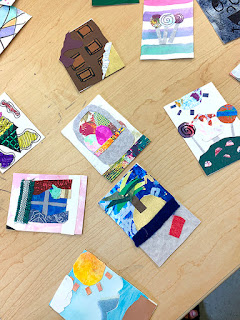
After every art project, collect the “good scraps,” as I call them, in a garbage bag. Think: leftover painted papers, bits of construction paper, gift wrapping paper, feathers, beads, felt, fabric, etc. Basically, any project remnants you considered tossing or don’t have enough to use for even one class, toss in the bag. 

After I’ve collected a big bag of random materials, I fill large bowls with the scraps for students to create artist trading cards. They cut, glue, color, and paint unique artworks that they can trade later on in the year with friends. On the last day of school, I do an all-day ATC exchange. The kids love it and it’s always such a huge hit at a very chaotic time of the year!"

If you’re interested in getting started on artist trading cards, check out her complete teacher guide, lesson plan, worksheets, and PowerPoint slides. She'll walk you through the entire process.

RESOURCEFULNESS AND CREATIVITY

Limitations often fuel creativity, and recycling presents the perfect opportunity for students to think outside the box. By repurposing materials that would otherwise end up in landfills, students are challenged to find new uses and innovative ways to incorporate them into their artwork. This encourages resourcefulness and cultivates a mindset of creative problem-solving—a valuable skill both inside and outside the art classroom. Whitney from Look Between the Lines has some impressive 3D inspiration for us:

"My favorite Earth Day project is my found object assemblage project. This is a great way to bring sculpture into other art classes or focus on a found object-style sculpture in your sculpture classes. This can be introduced on Earth Day, with a focus on what materials can be reused and turned into a work of art. My favorite found object artists are Tara Donovan and John Dahlsen, I use them as artist exemplars to inspire my students before they start their project. Students are responsible for collecting their materials. While waiting for materials to come in they prep wood panels, where they attach their materials, brainstorm and research ideas, and sketch out designs. Experimentation and thinking ahead are key to creating a successful work of art. I also recommend having an in-progress and final critique with students as they work on their assemblages. 
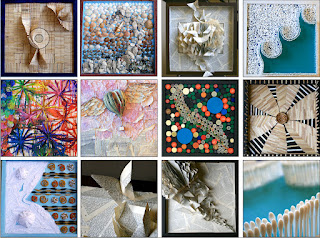

This project can be taught to students as young as 5th grade, I recommend working on one piece as a class project. For middle schoolers, I encourage small groups of students to work together. In high school, students can pair up or work individually."

Read more detailed information about Whitney's Earth Day assemblage project here or hit the easy button and get the lesson pack with everything you need to teach the project (minus the supplies) here


EMPOWERING STUDENTS THROUGH OWNERSHIP

"Embracing recycled materials as art supplies in an elementary classroom is not only cost-effective but also instills a sense of environmental responsibility in young students. Sorting bins for various reusable items such as cardboard, scrap fabric, colored paper, string, and containers transforms waste into a treasure trove of creative potential. This approach encourages children to see the value in everyday items, fostering a culture of sustainability and innovation. For instance, cardboard pieces can become the canvas for a collage, string and fabric scraps can be woven into a textured tapestry, and old containers can be transformed into whimsical sculptures. Such activities nurture creativity, as students learn to work with what's available, adapting their artistic visions to the materials at hand. This method is particularly beneficial for schools with limited budgets, offering endless possibilities for artistic expression.
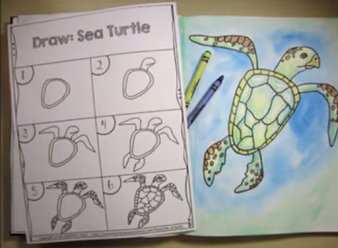
Directed drawing activities, like the Earth Day Themed Directed Drawings, provide a structured yet flexible framework for art projects. These guided exercises can be adapted to whatever materials are on hand, allowing students to choose from a variety of mediums or work with specific ones based on current supplies. This not only enhances their drawing skills but also teaches them to be resourceful and imaginative, key qualities in both art and life. "

If this sounds like the perfect activity for you, visit her website to plan quickly and teach confidently.

BUILDING CONNECTIONS

Recycling in the art classroom provides an opportunity to forge connections with the broader community. Partnering with local businesses, recycling centers, and environmental organizations can enrich students' learning experiences and expand their understanding of sustainability initiatives in their community. Many times art teachers are the recipients of large scale donations of random materials from community partners. Next, Sabrina from A Space to Create Art shares an example of how to use donated boxes or containers to creating meaningful artworks.

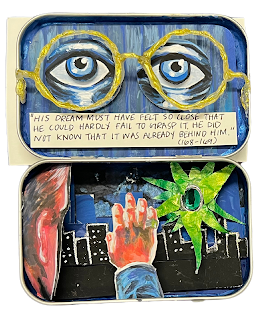
"In this assemblage piece, high school and middle school art students learn about artist Joseph Cornell and create a mixed-media sculpture inside a mint tin. Their art is based on a famous novel’s quote or theme. By marrying visual art and literature, they delve into the nuances of storytelling, exploring themes, characters, and settings in a tangible and tactile form.

Joseph Cornell was known for his pioneering work in assemblage art. Cornell's distinctive style transformed found objects into captivating compositions housed in shadow boxes and glass-fronted cases. His pieces often evoked a sense of nostalgia and wonder, blending elements of surrealism and collage to create dreamlike worlds.

As students breathe life into their sculptures, they embark on a personal and introspective journey. Each sculpture becomes a testament to the power of imagination and the transformative nature of art. Below is an example created by a student based on the novel The Great Gatsby by F. Scott Fitzgerald."
You can find this lesson ready to teach at A Space to Create Art on TpT or on her website: www.aspacetocreateart.com

FOSTERING ENVIRONMENTAL CONSCIOUSNESS

Exposure to Earth-friendly art-making approaches can encourage our young artists to think in a globally conscious, macro beneficial way. By being environmentally-thrifty and eco-aware in our art teaching, we potentially seed future creative solutions in our artists, while providing them with some ‘food for thought’ regarding their own use of the earth’s limited resources.”


In her blog post hereStephanie shares a few practical tips for earth-friendly (and budget- conscious!) art materials, equipment and supplies. Check out her TPT store here here.

CONCLUSION

Integrating recycled materials and sustainable practices into your art room offers a multitude of benefits that extend far beyond the school day. Changing a few habits or lessons each year can have a monumental impact over the course of your career.  Need help getting started? My previous post on Earth Day lessons has several project ideas you can incorporate easily.  By embracing recycling as an important part of the artistic process, educators have the power to inspire future generations to create positive change—one masterpiece at a time.


ART TEACHER-AUTHORS THAT CONTRIBUTED TO THIS ARTICLE:

Stephanie from Picassa’s Palette
Amie from Glitter Meets Glue
Whitney from Look Between the Lines
Kathleen from Ms. Artastic

Saturday, November 21, 2020

Collaboration in the time of covid

Recently I've been seeing lots of questions from teachers looking for ways to incorporate some classic collaborations like exquisite corpse. It is, after all that weird time of year where many of us have a short week ahead, maybe some half days or conferences and you're trying to even things out. Grades are probably due and you need a fun break.


While I do have an answer for your exquisite corpse quandary (hint, templates and contact points) why not use this time to expand our art teacher resource bank of collaborative art activities. I recall a fun idea from Ian Sands including post it note mosaics/murals many years ago. Assign each student a color, let them add to a giant wall sized mural. Use the smaller 1" size and break it into 3-4 smaller murals. Great article on murals here. Ian's lesson is available for free here.


(c) Image Ian Sands 2012

Some clever teachers are reinventing this lesson by having students work in shared documents like google sheets to take turns filling in blocks of color to create their images. Some are assigning students into breakout rooms and giving timed contests.

What about a collaborative collage? In this lesson, students are reinforcing their working definitions of juxtaposition, positive and negative space, as well as texture and pattern. Students can share an original drawing or photo of their choice to a folder or space in your virtual classroom. Other students choose a picture that inspires them and they cut out a piece. It is their job to fill the void with a new pattern on texture by holding the photo in front of a variety of objects. 

It is great fun for students to see their reimagined photo. Like a Flat Stanley for the art room! For this lesson have students look at the work of Shamekh Bluwi,  the inspiration for this lesson.


What fun ways are you allowing students to collaborate?


Sunday, October 18, 2020

The Monster Mash Up

Some lessons are timeless. Six years ago I posted an exquisite corpse lesson plan that I have done with students in grades 3-12 and I am still hoping I can sneak it in this year now that I'm back at the high school. Right now my cartooning classes are developing original characters and it might be fun to have them submit and edit these digitally.


Since posting that lesson, I have added these fun muddle and match books from usborne to my growing resources for the project, which include a halloween card from 10 years ago.

The topic of "seasonal" art is sometimes hotly debated, especially at the high school level. I think an art teacher in an exploratory course like Art 1, could definitely make connections to surrealism and this could develop beyond a fluff piece for decoration. While I wouldn't have students collaborate their paper drawings this year, a technology connection could make this more interactive and add a layer of engagement and excitement.

Do you use seasonal inspiration for middle and high school art classes?


Saturday, March 24, 2018

Felting Progress

Mallory Zondag has been hard at work on the living wall installation since she left us this fall. The students are going to be very excited to see the progress. Every piece was hand made by our K-5 students.


Approx 48 x 52"

Monday, December 4, 2017

Artist in residence

Today was the last session with our visiting artist, Mallory Zondag. Every student in 3rd-5th grade choose a flat piece of felt to contribute to the piece and every student K-2 choose either a sphere or a cord to include. All other pieces were theirs to keep. She will combine all of their pieces onto the giant 5' x 5' felted background that all students worked on in class and it will hang prominently in our school.


Wednesday, November 22, 2017

Felted Spheres

During our 30-minute classes today the K, 1 & 2 students made spheres with felt. This may become rocks or pebbles in the final design. This was the second session with our artist-in-residence, Mallory Zondag.


Wednesday, November 15, 2017

Artist In Residence


Our visiting artist, Mallory Zondag, started today and it's been amazing to watch the students blossom under her guidance. We are constructing a living wall of fiber using wet felting techniques. Every student K-5 has the opportunity to add to the collective 6 foot square background. Grades 5, 4 & 3 are creating sheets of felt that will be needle felted on top of the background while 2nd, 1st and kindergarten are creating cords that will be used as textural embellishments.

For the flat pieces the students tear and place five thin layers of wool roving, alternating the layers as they stack them on their mat. The mat is a piece of pool covering but you could use a sushi mat or bubble wrap.

A mesh screen is placed over the five layers and then the warm soapy water is used to scrub over the entire pile. We used an olive oil based soap.


Next, they remove the screen and roll over top of the felt with a pool noodle wrapped in the other end of their mat. They agitate for about two minutes. Then we added five more layers to the pile and repeat. They could change color if desired.


For the corded pieces, students received about a yard of roving to wrap around their palm several times. They dunked their hand in the soapy water and rubbed their hands together to agitate. They needed to rotate the wool around the hand so that it was evenly felted. After a few rotations they had  to unwrap the cord and squeegee off the excess soap.


We store the kits by rolling the mats around the pool noodles, stuffing the screen in the open hole of the noodle and securing with a rubber band.


Here is their progress so far:

Saturday, February 6, 2016

Dreams


Riding the wave of the classroom discussions of Martin Luther King's Dream Speech, this month I introduced two dream inspired projects. My first graders began a painting unit. For three weeks students created sheets of paper using marbling, wet on wet, gradations, squeegees, stippling, blotto, diffuser paper and more.


During the last class, I read the book "Dreams" by Ezra Jack Keats. The students were excited to search for "their" techniques in the book. I like this reversed format of ending with the book instead of starting. We focused on an illustration of the apartment building where everyone is dreaming. We used their paint explorations to fill each window where someone is dreaming.


The second lesson is a collaborative one I started with our music teacher. During their lesson last week, I read the book The Drum Dream Girl by Margarita Engle. We talked about discrimination and determination. The illustrations in this book are so vivid and layered. The students loved searching for patterns as I read. I find that if I give them a job while reading, whether it be a word to listen for, or a specific thing to spot, it increases their engagement. In this case, they were on the hunt for patterns, and were to give me a quiet "thumbs up" whenever they spotted one. The music teacher reinforced the use of repetition and patterns in music. We will be following this up next week with scratch art illustrations of a drum of their choice.