_

Showing posts with label video. Show all posts

Sunday, June 1, 2025

Toy Story Gets A Glow Up

One of my favorite two point perspective lessons for my upper elementary students was inspired by the movie Toy Story. This year, I finally did not have any of my previous students who completed this lesson in a high school class and was able to move that lesson up to Art 1. 


If you've been following this account for awhile you already know  I've been mixing up my two point perspective lessons over the past 4-5 years trying to find something that resonated. We did perspective rooms, streets and houses. We've done them in pencil, watercolor and acrylic. Nothing was hitting the way that Toy Story lesson always seemed to with the younger kids, so I thought "why not?" The great news is that 14-18 year olds are still inspired by Toy Story. We are a 1:1 ipad school and my students are lucky enough to have the procreate app. 

The basic format of my perspective unit still remained the same. Starting with 1 point boxes, comparing 1 and 2 point perspective. Introducing angles like bird's eye and worm's eye. One of the fun ideas I added to this recycled lesson was showing short 3-5 minute clips from the movie and freezing the screen. This allowed students to identify the horizon line, vanishing points and angles.

I had a collection of toys in the room with a set up for them to photograph for reference and they were welcome to bring their own in as well. All students experienced a high level of success with this lesson and were eager to work on it. I find with paper pencil, students get so discouraged having to erase the lines over and over again, ruining their paper. This felt like the perfect time to go digital.

If you'd like to "just press play" on this video heavy resource you can find it here.

If you're an elementary teacher who'd like to see the original post use this link.


Sunday, May 18, 2025

Seasonal Grid Drawings

Semester 2 proved to be a little more challenging for the new square paper / no measure grid drawings. In the fall we used leaves, which were readily available for both students and myself. I brainstormed other items that might provide a similar range of challenge and came up with a few. If you're looking for more grid drawings, I have now added:

Food (lemons, peppers, red onions)


White Eggs (on neutral backgrounds, in cartons and on plastic easter grass)


Pool (Billiard) Balls 


Here is the fun set up in my home when I realized I could borrow the balls from a neighbor but did not have my own table. Thankful my daughter has sweatshirts in EVERY color

What objects have your students enjoyed drawing using the grid method?


Monday, December 2, 2024

Square is where it's at for grid drawing

I've been a HUGE fan of grid drawing my entire career. Starting with my elementary kids I would introduce the concept of using grids to my students often with preprinted grids on cartoon characters as an early finisher activity. 


As students mature in their skills we transfer the responsibility of grid making to them. And you know who doesn't love a grid project? Every student who struggles with reading a ruler. Sure, there are workarounds. I can print the grid on it for them, they could work on gridded paper or worksheets. They can use a light box to trace a pre-drawn grid, we can place a grid on top digitally. When drawing isn't the main skill, like this printmaking lesson that is a great accommodation.


Most of those techniques require a lot of extra preparation from the teacher. They also take away what students need to use this technique again on their own: the ability to execute a grid, consistently on the reference photo and their own paper. Let's face it, if they can't make a good grid, it's not a helpful tool. In this case, the grid becomes a barrier to success.


This year I started using a NO MEASURE grid method. If students can draw a straight line from corner to corner, they don't need to measure a thing. The only limitation to this method are that you must either use a square or make sure the reference photo and the final paper are the same proportion. Both of these steps require no extra effort, time or resources from the teacher.  We tested this new format with a colored pencil leaf drawing. After seeing the boost in confidence for all of my students I decided to create some additional lessons that are ready to go for a sub at a moment's notice. You can find the whole bundle here.


In this resource I include a step by step video demo of not just how to set up the grid, but how to see implied lines in a photo to convert a photo into a line drawing. This is an important step to teach. Not all students can visualize what you are asking them to do. We start with a basic star shape to help them see the lines where there are none.


If you'd like to check out this method, you can download a FREE sample here

Friday, March 1, 2024

Women's History Month

I love to share the story "The Drum Dream Girl" with my classes in March for Women's History Month. This lesson is packed with interdisciplinary connections. Divide the drum into section. Apply patterns. Write a haiku to describe your drum.


Original post here.
Download the complete lesson plan with time lapse video demonstration here.

Monday, January 17, 2022

Snowmen at Night Printmaking Video Demos


If you're looking for a printmaking lesson that can be scaled up or down for a variety of grade levels, this is a favorite. Inspired by the book snowmen at night, students can create crayon rubbings (K-1) marker prints (2-3) and traditional prints (grades 4-5). 


Original post from 10 years ago here.


Monday, June 14, 2021

Teaching line and rainbow order together


I love teaching students about different types of lines using the book "Lines That Wiggle" and after a crazy remote year, it just made sense to offer this lesson with two video demos (one for each project). Original post here. 


Lesson plan with fully narrated video available here.


Friday, April 2, 2021

Spring Cleaning

Teaching from home has done a number on my organization system. Using these two days off to get things back in order. It's always fun when you stumble across little gems from the past. This student made a flip book just for fun after an introduction to animation techniques. She didn't want it back, was getting ready for college so I got to keep it. Enjoy!


Thursday, April 1, 2021

Abstract Lyric Painting


Paul Klee has always been a fun artist to introduce and discuss the ideas of abstraction with students of all ages. My high school students enjoy the opportunity to connect their favorite music to an art project. This brings together composition, the elements of art, color theory and art history. 


Several years ago, I did this lesson as messages of thanks placemats exploring warm and cool color schemes using markers with elementary. It's been fun to remix an old favorite for the high school level.


Friday, March 19, 2021

Printmaking Workshops

Over the past week Art 4 students have been catching up on a variety of printmaking techniques using a workshop format. Many of these amazing students have lost the opportunity to engage with authentic materials over the past year in their Art 2 & 3 classes during covid for the Spring and Fall semesters. I want them to experience the joy of printmaking without worrying about a finished perfect project. 

Their first encounter was using gelli plates. Here are the results of the first attempts:


Here are some fun explorations:


Student's first monotype using watercolor on plexiglass

Student's set up for the monotype. Soap used to break surface tension.


Rubber bands on gelli print on newspaper


Marker Print on drawing paper (styrofoam plate)


Layered block print on a gelli print on a worksheet. 


Layered block print on block print on magazine paper


Block print on roll-off paper (used for cleaning brayer)


Layered block print on a gelli print (stencil)


Layered block print on a gelli print (stencil)


They will begin planning their printmaking project and choose from a range of techniques having had an appropriate amount of time to learn and experiment. I made a video  for the remote students including some of these techniques as well as a video for creating dry point prints with recycled materials from their home.


Sunday, July 26, 2020

First Day Of School

Everything about the first day of school is going to be different this year. Starting my 16th year in a different room...different school...and just for fun, a different level than last year.

So what will that first day look like with social distancing and half of my class in attendance? Right now I'm thinking priority number one is going to be making sure kids are connected to my virtual classroom. I'm not a huge fan of reading a syllabus to students, so I'm thinking of how that can be made more enjoyable. They will also take a survey to help me identify experience and learning styles and to set some goals for themselves.

Having them complete the survey and goal-setting using google forms ensures they are all connected to our classroom. But do I really want their first day of art to be staring at a screen filling out paperwork?


Introducing "What do you meme?" Art Class Edition.


Photo credit Ryan Franco via Unsplash

In (6' apart) pairs, students will receive a prompt related to one part of the syllabus and respond in the form of a meme. They may photograph each other using their ipads and add text. If we end up being online, I will share the powerpoint to google slides and let them work on it by themselves.


** Update 7/31/2020 **
I just created a resource for this and it's now in my TpT.

Wednesday, July 8, 2020

Mark Bradford Art Lesson

Switching grade levels is a great time to explore new artists. I've been looking at my former curriculum and finding areas where I can infuse more diversity into my lessons. I'm really excited to share this high school art lesson inspired by contemporary artist Mark Bradford.


It's formatted for face to face or distance learning, since I don't know what the fall will look like. Either way, this artist is a great springboard for discussions about social issues in art. Choosing an artists who works with found objects and ephemera is perfect for those students who may be sitting around the house without art supplies. A win-win-win!

If you're not familiar with Mark's work, this is a great interview with Anderson Cooper to get you started.

Saturday, March 21, 2020

Distance Learning Expansion

For those who have purchased lessons and resources from me in the past, thank you.

I updated/clarified my Terms of Use to reflect current practices and expand the use of my lesson plans, resources, videos, presentations and worksheets for distance learning situations. You may now privately share relevant portions of this resource with your students via a connected classroom platforms (google classroom, schoology, etc). This is retroactive and applies to all resources except clip art.

Our school is likely moving to distance learning this week and I will continue to share what's working well for my students. On a personal note, my husband's place of employment is now closed temporarily and this little side hustle is a huge help to our family. For that I am very grateful to each of you.

Thank you and stay well.


Thursday, February 6, 2020

Pop Art Valentine Animals


I saw a video on youtube for a project with a puppy wearing sunglasses and thought it would be great for my 2nd grade. I had planned for them to do a stamping activity but wanted to switch it up from last year's donuts. I really liked the idea of making stampers from cardboard shapes. We started out talking about unity, variety and emphasis. 


I use this little worksheet to let them practice with really basic shapes. Next they did their stamping. These two activities took the whole 40 minute session. Instead of just doing hearts, I also showed them an option to roll the paper up and create a rose shaped stamper.


I don't know about you, but I always feel a little off when I'm teaching someone else's lesson. One of the things I wanted to do was give the students choice. So instead of drawing their project along with her video, I created some animals of my own and then some of hers. 


While prepping this lesson, the devastating fires hit Australia. So one of the animals was a koala bear and that lead me to thinking about animals where I could easily use hearts. Quickly a raccoon and beaver (or groundhog...cause, you know - February) became part of the menagerie. 


I printed out samples and let the students choose from a wide variety of animals or their own. I swapped out the puppy bow tie for a heart-studded collar and encouraged students to make changes, too.


I decided to push the pop portion of the artwork and students were encouraged to choose a limited palette for their colors. We talked about popular culture, putting stickers on water bottles and I showed them some examples of how stickers have a thick white outline around them, so we cut ours out with a border. 


They did a great job and have gotten many compliments. Glad to have these cuties hanging in the halls in time for Valentine's Day. If you're looking for step by step animal drawing pages or valentine coloring pages, I posted my three animals here. 

*** Updated for 2021 with sheep, goat and panda. So now 6 animals total ***


How do you adapt lessons to make them feel more like you?

Saturday, November 2, 2019

Leaf Printing

Wow! Elementary school in one building just flies by. You don't realize how much there is to do when you have multiple buildings until you don't! My emails are cut in half, my prep is cut in half and not sharing a room has lowered my stress level by oh, maybe a bajillion percent! One of the things I've been able to do this year with what feels like "free time" is push down some more advanced level projects and the kids are responding to it.

This week we started printmaking in 3rd and 4th this week.

Third grade is going to be leaf stamping while fourth grade is gelli printing with leaves. Links will take you to the video demos I shared with my students. Either of these lessons would be an easy fit into TAB classrooms by allowing them to explore a variety of techniques.

Saturday, July 20, 2019

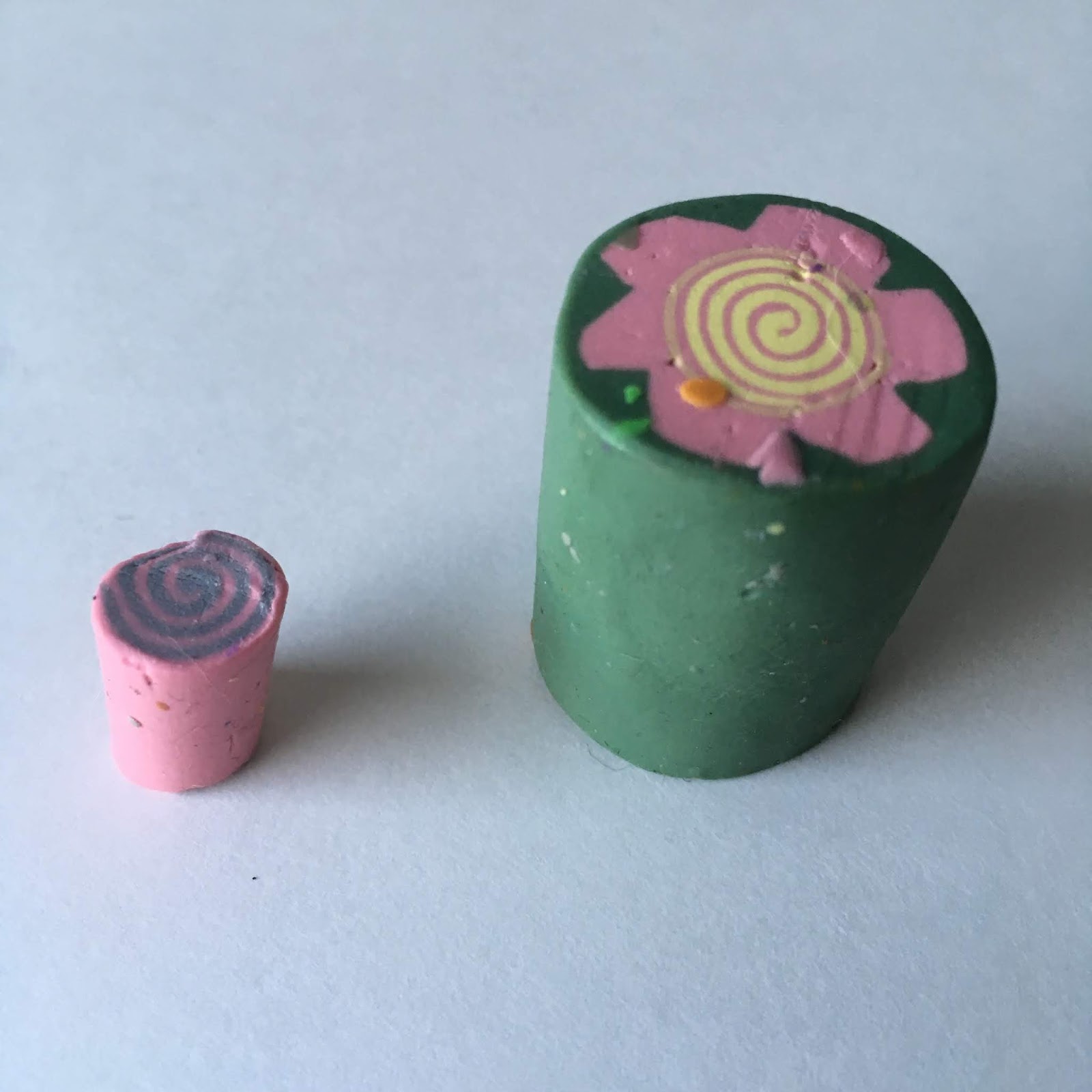
Beyond the basic bead with polymer clay


I've been revisiting some of my high school lessons to see if anything makes sense to bring down to the elementary level. Given their huge success rate with polymer clay on the bobbleheads, I may try some basic jewelry making again this year. A few years ago, some of my fourth grade classes created beads that were accents to their arcimboldo shrinky dink heads.


I'd love to have them try some advanced methods like caning.


The samples here were made by my high school students in a contemporary crafts class.


It's such a great way to introduce unity, variety, repetition and emphasis


I love to watch them go beyond the basic bead and explore a variety of shapes.


Here's a link to the high school lesson plan.
And here is where you can get my video tutorial and lesson plan that would be great for 4th-6th grade.

Monday, June 24, 2019

Balloon Animal Paintings

Lately there have been a lot of teachers posting the adorable Jeff Koons balloon dog ornaments that are available right now. I'm in no way prepared to think about Christmas on the first week of summer break, HOWEVER, I am totally down with some lesson inspiration.


I love the way painting with parker lends itself to the transparent quality of a balloon. If you'd like access to the video tutorial, lesson plan and support materials they are posted here.

Sunday, May 12, 2019

The year without a kiln

Moving back into our remodeled school left me (temporarily) without a kiln. This has been forcing me to revisit and tweak old lessons, to remix and rethink the existing lessons.

 One of the benefits of teaching at two schools is that I can try something out and if it doesn't work, it doesn't make it to school number two. 


The first time I taught the bobblehead lesson it was really close to the end of the year so I used polymer clay. The next two times I went with regular clay. While I like that and the students LOVE that, when I sit back and compare the end results of each, the polymer clay projects are more original.


The students were more creative because I let them be. And I will own that one. With clay it was "dog or a cat. If you want to do something else, you need to know how to make it happen." Because we have 40 minutes (and let's be honest... that's really 30 minutes of work time).


But the polymer clay lesson can go a little longer. If they want to spend a class and a half on the head but 20 minutes on the body  - it's no big deal. You wanna make a football player, a dragon or a funky alien bot? You go for it, fifth-grader. I'm not trying to keep everything the right amount of damp. And that, ma friends, is really liberating.


So. Presenting polymer clay bobbleheads. Take Two!


This lesson was inspired by the clay version on Cassie Stephens blog. If you are interested in that, check our her blog. If you want to download my lesson plan, video and historical powerpoint that is offered here.