_

Showing posts with label classroom management. Show all posts

Friday, February 2, 2024

Paint Organization and Distribution Tips

 Here are some quick tips to make paint distribution and storage easier in your high school art class. This system has worked for me in a 41 minute period setting and a 78 minute block setting. For reference, this is a small classroom (no walk in closet) and another teacher uses my room during another block as well.

Option 1: Individual palettes. I have a shelf for students to keep their palettes on. Assigning a numbered spot let's them know that I know who's being messy. I can fit 20 of the 7" round palettes with wells on each shelf. 

Pro: cuts down on waste. Easy to save mixed colors

Con: have to mist with water and wrap palette daily. 


Option 2: Cups of paint. I have a tin of each primary, secondary and neutral color. Each pair of students gets 1 cup of each color to share. They access it from a communal table. At end of class they return the cup. I mist all tins with water and put the lid on. You can also add a wet sponge to keep paints moist over a long weekend. For my upper levels I have two kids share one of these tins for the duration of the project.
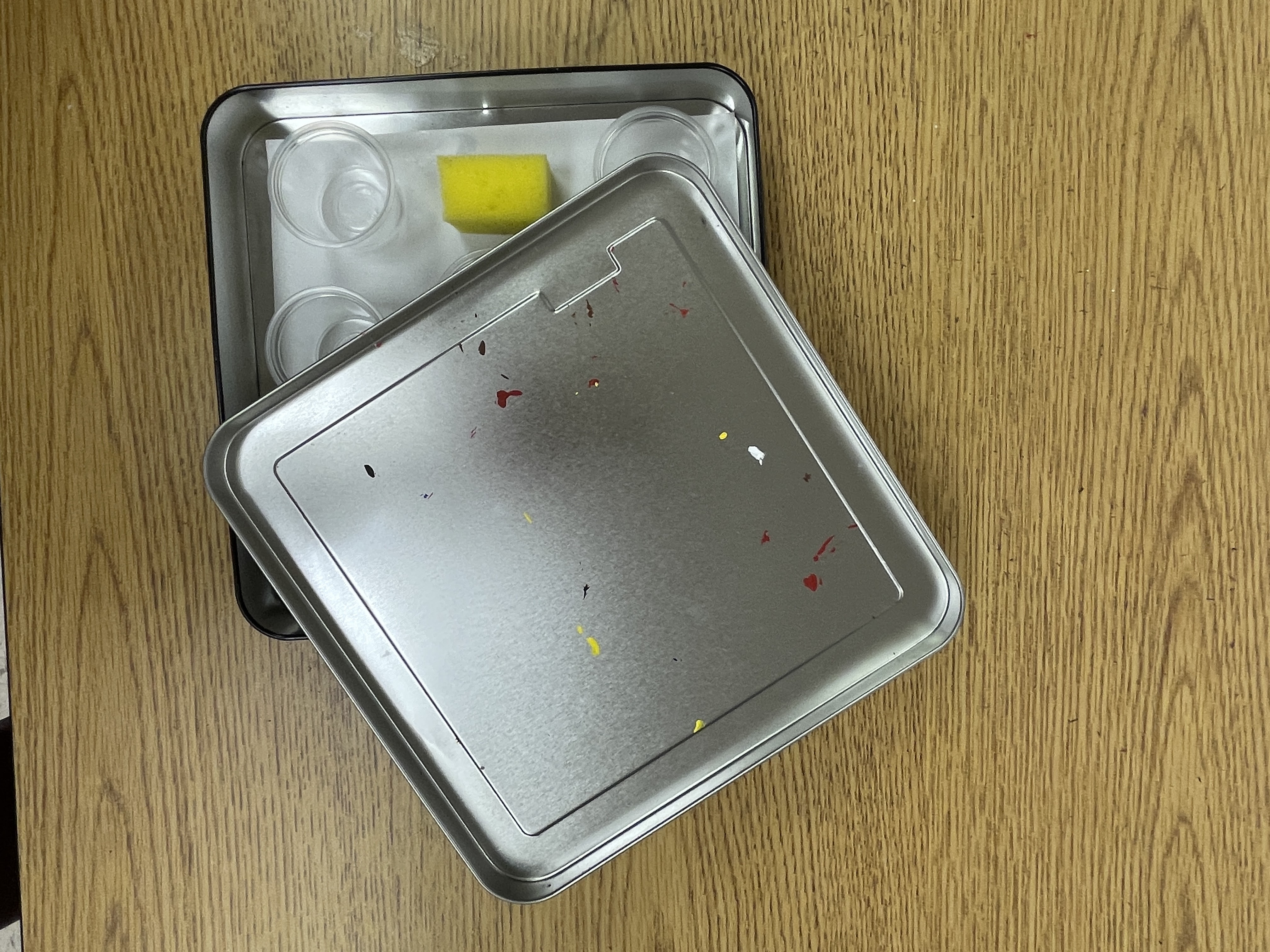

Pro: These stack neatly and take up less room than traditional palettes.


You could also use cheap dollar store pencil cases


Con: Students will need palette paper, you need to buy and replace the cups or trim the palette paper to fit the size of the box.

Tip: I keep the wax / palette paper in a readily accessible location for quick self service.


For paintbrushes you can try the over the door shoe hanger. I number each kit and each pouch space. 
At the end of class I can scan quickly to see who's missing. Also, I don't have enough for every student. Student #5 in my first class shares with Student #5 in my second class. I tell them to let me know if the brush is dirty at the beginning of class. Then I make a note to speak to that student the next day. It only takes 1 or 2 kids for them to realize that they can't get away with not washing brushes.
Pro: kids check brushes instead of you, saving time.
Con: brushes not cleaned last period of day will be gross the next day
Fun Fact: sometimes students tell on themselves. I had a kid show me a horrible brush. When I looked to see who shared the set, the student in the other class was absent. So he was the last to use (and not clean) the brushes.




Sunday, July 31, 2022

High School Organization Ideas for New Art Teachers

** UPDATE** ALL of these (and more) can now be found in a FREE 15 page download.

This is a post to easily share my answer to some of the common questions that pop up each fall in my high school facebook groups.

Q. How do you store student artwork?
A. Flat, dry work in progress goes inside their personal folder, stored on a drying rack. 
     
Flat, wet work goes on top of their folder on the drying rack. I number the shelves (they get a number for everything. Their folder goes on their shelf number.


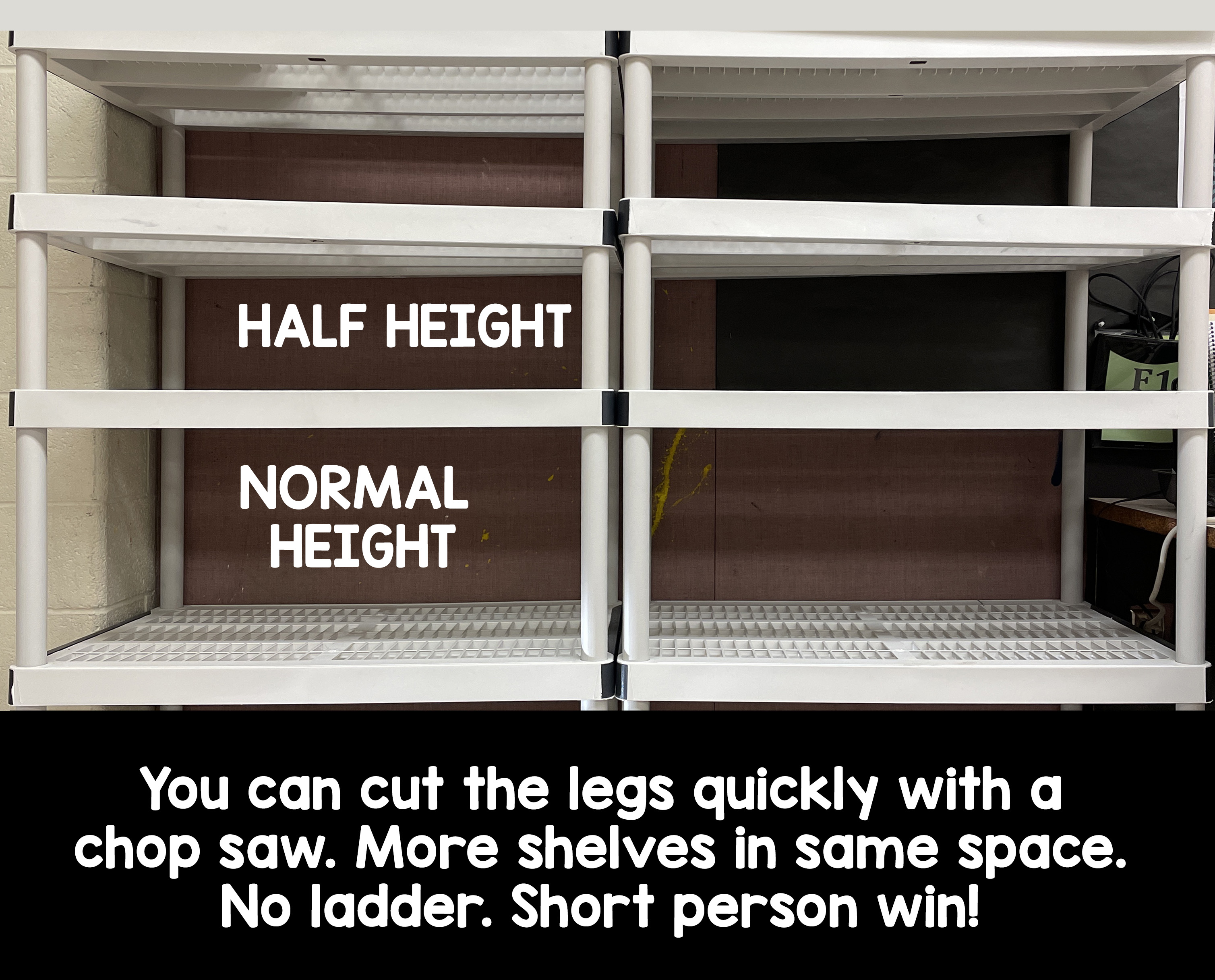
3D work goes on the shelf labeled for their class. I cut down the legs of the snap together plastic shelving so I can fit more shelves and still reach the top.


Q. How do you have students submit work?
A. Students photograph their work. I use this powerpoint to teach them how to upload quality pix. They turn in the photos using our LMS (Schoology for me). They put the actual project into the grading box on a labeled shelf. If I can't see the work well enough in the picture, I can go to the box to find their work. Usually the picture is enough to jog my memory of what I have seen and been observing in class. It's a visual reminder.


Q. Do you assign seats for High School?
A. Yes and no. For all level 1 classes, they have assigned seats for the first 2-3 weeks to help me quickly learn their names. Around that point we start working on observational (still life) drawing, so then they choose their seat so they get the view they want to draw.


Q. How do you grade High School Art?
A. Project rubric for all studio projects. And by this I mean an articulated rubric. I am not a fan of printing a giant sheet of paper when you are just changing the word inside the block from "Outstanding" to fair. Sorry. If I'm going through the trouble, then each block is going to specifically say what is different. 


Q. Do you do bell ringers or warm ups?
A. Yes. We are on 78 minute blocks now, but I also did them when I had 41 minute periods. I believe students need that transition time. This post explains how it's a great way to slip in more art history.


Q. Do you decorate your room or have a theme?
A. I post the elements and principles of art (mini posters) on my cabinet doors. I have a set of beautiful posters that were free from amplifier.org that I hang behind my desk. It was a giant mauve bulletin board, and I used black butcher paper to cover the horrendous color first.


I'm a fan of "less is more" so I do not have borders, or crazy printed wallpaper or 1,000 paint chip samples glued to my desk. If that's your jam, go for it! I also don't have student painted ceiling tiles or murals because I have inherited rooms with them in the past and it makes the room feel small and chaotic. I would highly encourage new teachers to have kids do this on a canvas or butcher paper, especially if your district moves people or rooms frequently. 


Q. Table bins or individual supplies?
A. For hard goods: scissors, rulers, etc I have bins on my counters and they self serve, 
     
For painting, I have 20 sets of brushes in a cardboard "packet" that is shared between classes. So when student #1 is done, they put it in the #1 spot. When my 2nd class comes in, if student #1 has messy brushes they tell me and I discuss with that student the next day and they have to show me their paint set before they leave each day.  I've also used the over the door shoe pocket holders for this purpose.


Every student gets a personal art kit that they should have one them every day. We started this during the pandemic and it has been a time saver. Once our drop/add period is over, each student gets a gallon sized ziplock bag with 2H, 2B & 5B pencil, one eraser, one pencil sharpener, one black sharpie, one cheap stylus (for digital work) and a glue stick. The last two years I gave a watercolor set, brush, about 10 feet of plaster craft in a brown paper bag stapled shut. I told them to take these items home in case they got quarantined or the school was closed. See how I made cheap watercolor kits for each student.


Q. How do you group / organize supplies
A. I am lucky enough to have about 160 of these sliding bins. Don't be too jealous, I do not have a proper closet. My room is like a math room with a sink. Also not everything conveniently fits in something 3" high. But I work with what I have. Because there are so many, I keep my supplies in alphabetical order. It helps me remember where they are or if I need to direct a kid to get them, I can more easily explain where they are.


If we are using colored pencil, I will pull those bins out and place on the counter / window sill until that project is over. I keep them sorted by color and used scraps of cardboard to help subdivide the bins (but you could totally buy mini bins at the dollar store.


Utensil organizers are also good for separating colors or types of paint brushes.


What other organization questions do you have?


Wednesday, August 11, 2021

Learning Student Names

As an elementary or middle school art teacher, we are often tasked with remembering the names of 600-900 kids at a time. Not an easy task. Add to the amount of times you may switch buildings and over a lifetime of teaching, that's a LOT of names. We all know that classroom management gets easier when you can address students by their name. And yes, they know "sweetie" and "buddy" aren't their real names.

One of the easiest hacks that I use for remembering student names is to have them design a name plate.


Using basic construction paper or card stock, students can make a folded table tent that will stand up and be seen from the front of the room. I like to slip in the element of line with this activity and do a little negative space / implied line lesson. It lets them be makers on the first day and that goes a long way.


I know many teachers like to have students decorate a folder, but this lays flat on the table and can be hard to see. Students often make the name small or hard to read. When the name BECOMES the focal point (hey, there's more art vocabulary we're knocking out) you will get something that is much easier to read.


The tents are stackable, so if you don't use folders, a class set takes up very little space. You can color code them so you know which go on which table. They flatten out and can be placed inside a table folder at the end of each session. It gives the kids a sense of ownership in their space. Sometimes at a shared table, it's hard to find that. But you will notice them keeping their area clean, because you know who sits there. 


If you need a lesson plan with a video demo, this is what I use.

Sunday, January 3, 2021

Tips to Ease Back To School After Winter Break

Well, that went fast! With the absence of many of our normal family and friend gatherings, this break was very different. Maybe you set some goals for the coming year that are tied to self care and organization. Perhaps you've received a last minute notice that your instructional model has changed (yes, again!). I've been busy updating many of my resources to include remote learning strategies, videos and editable files and will continue to do so this year. I've bundled items that create entire courses and included helpful editable documents such as syllabus, scope and sequence and final exams when possible. Here are a few items that may help you transition back into teacher mode:


Up first is my Free Art teacher's guide to organization. It's over a dozen pages of practical tips and strategies to streamline your class routines and preparation. It's been edited and revised dozens of times since first published about 7 years ago.


Distance learning clip art  to reflect our current spaces. I also have kids with masks.


High School Cartooning Course (Bundled Set)

- Could be used as stand alone units within a larger course. 


High School Crafts Course (Bundled Set)

- Could be used as stand alone lessons in your 3D, sculpture and applied art courses


Elementary Art Choice Board Bundled Set

- Could be used as options for choice focused classrooms, early finisher stations or sub plans. 


2021 Art Teacher Planner. 

New Year, New Start. Undated pages with a 2021 calendar included.


Google Classroom Organizational Headers in four different styles


Editable Syllabus

Easily organize and present an overview of your course to students 


Syllabus Meme Icebreaker

Turn reading your syllabus into a first day ice-breaker activity


Digital Interactive Notebook

Use google slides to create an engaging notebook. All the formatting and linking is done for you. Three styles (horizontal and vertical...with tabs)


Thank you for stopping by. Please share what you're doing to stay organized and sane in 2021.


Sunday, July 26, 2020

First Day Of School

Everything about the first day of school is going to be different this year. Starting my 16th year in a different room...different school...and just for fun, a different level than last year.

So what will that first day look like with social distancing and half of my class in attendance? Right now I'm thinking priority number one is going to be making sure kids are connected to my virtual classroom. I'm not a huge fan of reading a syllabus to students, so I'm thinking of how that can be made more enjoyable. They will also take a survey to help me identify experience and learning styles and to set some goals for themselves.

Having them complete the survey and goal-setting using google forms ensures they are all connected to our classroom. But do I really want their first day of art to be staring at a screen filling out paperwork?


Introducing "What do you meme?" Art Class Edition.


Photo credit Ryan Franco via Unsplash

In (6' apart) pairs, students will receive a prompt related to one part of the syllabus and respond in the form of a meme. They may photograph each other using their ipads and add text. If we end up being online, I will share the powerpoint to google slides and let them work on it by themselves.


** Update 7/31/2020 **
I just created a resource for this and it's now in my TpT.

Friday, July 3, 2020

Creating a high school art syllabus with infographics


While planning for returning to the high school one of the things I knew I could safely work on this summer was my course syllabi. Whether we are home, online, blended, hybrid...I'm gonna need a syllabus. Since I will be teaching four different courses this fall I decided to set up a template of the common things I need to communicate to students in each class.


To prepare for the possibility of distance learning I made it a horizontal format on Powerpoint so it will easily convert to google slides if needed. If we're in the building I could print it out as a two sided document. Making it into three columns helped to chunk the information, and allows it to be folded like a brochure for open house if needed.


There are lots of hand-drawn info graphics and colorful backgrounds. So my contact information is inside an envelope. The food and drink policy is in a hyrdoflask. Just because it's school policy doesn't mean it can't be cute.


If you'd like to use something like this in your class, but aren't sure where to start, I've uploaded the 100% editable powerpoint. I've included extra slides with more background choices, frames and infographics so you can choose what you want to build and customize your own.


Sunday, June 28, 2020

Organization in chaos


To look at my art room, you would never guess that the pile of clothes in my teenage room sometimes reached mid-calf. My mother often gleefully documented the mess in photos and wished upon me a slovenly teenager of my own. (Well played, mom. Mission accomplished!)


As a teacher, I pride myself on keeping an organized space. I find it calming in times of overwhelming chaos and uncertainty to be able to locate things quickly. Something about fighting the disorganized art teacher stereotype makes this Type-A behavior feel almost rebellious.

While teaching from home, however, I found myself sliding back to my teenage ways. I wasn't carefully orchestrating my days. I wasn't putting things away where they belonged. I hadn't even brought my plan book home from school. What was the point? We weren't going to be glazing our clay, were we? Day to day I was operating off a random pile of notes stashed everywhere.

Relatable?


During the last week of school, we were allowed back into our classrooms. Halfway through packing up I received a phone call informing me that a position at the high school had opened up and if I wanted to return there, after eight years in elementary, the job was mine.

So...you are now looking at (reading? listening to the ramblings of?) a high school art teacher. Again.

When I returned home that day, not knowing what the fall would look like, one of the first things I did was dig into my archived files to find and revamp the pages I designed for my high school art teacher planner. There are far too many things that are going to be uncertain this fall to rely on luck and my poor memory. If spring 2020 taught me anything, it is I. NEED. A. SCHEDULE.


This 100% editable resource is designed to meet the needs of both high school and elementary art teachers. I hope that whatever changes are coming your way, the opportunity to take a small piece of control will give you comfort amid the chaos. Enjoy, friends!


Overview of items:


Calendars. Year at a glance. Monthly. 16-month.


Single and double page planner spreads to see your week or cycle at a glance. During uncertain times, print a week at a time as you go. Customize it for your teach-from-home situation and then choose your "regular" schedule once you are back in the building.


Communication logs.


Supply order / Inventory list.
Sometimes I use a page like this to track down who I've lent supplies to so I get them back!


Reminders. Websites, usernames, password hints. completely customizable.


Tips to help your sub get off to a smooth start.


Pages for notes. Good for meetings or reflecting. Streamlined dating option on top.


Coloring pages. (We need fun things to do during meetings that aren't for us!)
I included 13 different designs.


National Visual Art Standards. Art Anchor Reference Guide. I like to have this on the last page for quick reference.

If you are ready to take control, no matter what the new school year brings, you can download the files to create your own customized planner here.


*** UPDATE ***
PREPRINTED 92 PAGE VERSION NOW AVAILABLE HERE.


Monday, June 15, 2020

Have Wheels Will Travel


Two years ago there was a good chance that I was going to lose my art room. In preparation for meeting with my principal I jotted down all of my questions. You know, at 2am when the thought of moving my room onto a cart played non-stop in my mind. I know many art teachers are going to be tasked with this challenge in the fall so when I came across the list while archiving files tonight, I wanted to share it. In no particular order:

  • When will I/we be able to provide input on what supports we will need to make this happen?
  • What area will be provided for the following:
    • Storage of materials
    • Storage (drying space) for wet items
    • Storage of work for art show
    • Storage of student work in progress
    • Storage of clay while drying out for kiln (or 3D work in progress)
  • What accommodations can be made for hand washing in absence of sink?
    • If purchasing baby wipes, will those items come out of general budget?
    • Will a para-professional be available to escort younger students to bathroom for clean up?
  • What time will be allotted for the loading and unloading of cart each day?(Beyond planning time). Will need 20 minutes to load and unload daily. This should not be part of planning period.
  • What system will we have in place for classroom teachers to provide seating charts and updates as they occur?
  • What changes will be made to schedule to allow passing time for moving between rooms?
  • What changes will be made to schedule to minimize need for elevator use?
  • What areas of classroom will be available for LAMP teachers to use during classes? This should be standardized and presented to staff so it is not up to individual teacher preference. I need access to Projectors, Doc Cam, Whiteboards, Counter Space and sinks
  • What is the budget for ordering carts to accommodate the needs of six grade levels of supplies? Recommend 2 grade levels per cart and 1 drying rack per floor.
  • What space has been designated for classroom teachers to utilize outside of their room while I am teaching?


Wednesday, July 17, 2019

Art Center for Early Finishers

As I was answering a post on an art teacher Facebook group, I realized that I never shared my new art center from this past year. I've always had a free draw situation, but wanted to link my early finisher activities to a classroom management system. And so my art center was born.


I use a point system for students to earn and track points to "unlock" more shelves. If you've been wanting to try something similar, check out this resource to create an art center in any space...even when you share a room or are teaching on a cart. There is a video about how that works on my instagram highlight.


My complete set up guide with walk you through the questions you need to ask yourself to make the art center of your dreams. It's jam packed with photos of many different set ups as well as samples of my point tracking system to maximize student buy in.

New to teaching? This is part of the ultimate guide for new art teachers. Check that out here.